DEEP DIVE

What is a business simulation?

A business simulation is a team-based learning experience in which participants take responsibility for a realistic business challenge, make decisions together, and see the consequences unfold over simulated time.

Participants test assumptions, navigate trade-offs, and work together to determine what happens next. Complex patterns and consequences that might otherwise take months or years to experience can be explored within hours or days, without putting real business results at risk.

A simulation places participants inside the business challenge

Explain the situation

A case, presentation, or framework can explain a business situation. A simulation places participants inside it.

Experience the situation

Participants interpret information, discuss different perspectives, agree on priorities, make decisions together, and respond to what happens next. They are responsible for the choices and their consequences.

A simulation models an interconnected system

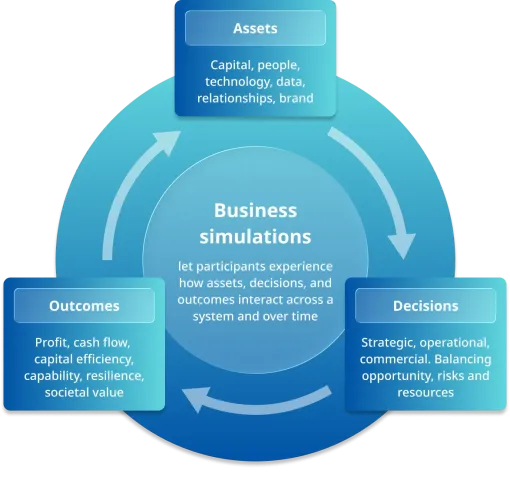
Every business simulation represents a system of connected choices and consequences. The scope depends on what participants are being asked to experience.

Assets are the context and resources participants have to work with, such as people, information, time, capital, technology, and relationships..

Decisions are the choices and interactions participants make, including priorities, trade-offs, timing, resource allocation, and collaboration.

Outcomes are the financial performance and other relevant KPIs those choices produce, such as customer results, project performance, people, resilience, or agility

How a session actually works

Participants begin with a situation, challenge, or opportunity. They review information, discuss what it means, and agree together on a set of decisions. The simulation then shows how those choices combine to shape the outcome.
Most simulations continue through several rounds. Teams review results, compare approaches, challenge assumptions, and adjust the next set of decisions. Much of the learning happens in the discussion between one round and the next.

Teams, rounds, and facilitation

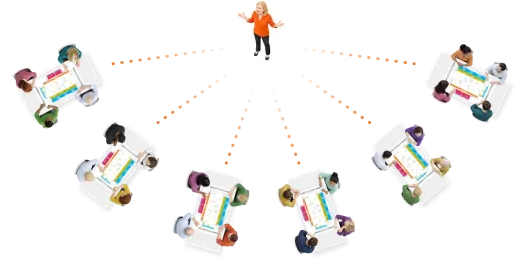
A common Celemi setup includes six teams of three to four participants, led by one facilitator. Teams work through several rounds of decisions, with reflection and discussion built into the experience.

The format can also be used with smaller leadership groups or scaled for much larger programs and events.

The setting is simulated. The collaboration is real.

Participants may be working with a fictional company, project, market, or challenge, but the interactions within the team are genuine. They analyse information, challenge assumptions, persuade one another, disagree, compromise, and ultimately take responsibility for decisions together.

That creates real reactions. Teams can experience uncertainty, frustration, surprise, relief, disappointment, and pride as they see the consequences of their choices. These reactions give the facilitator rich material for reflection and help make the experience memorable.

Competition can be side by side or head to head

Side-by-side competition

Teams work through the same challenge in parallel. Their results can be compared with one another or with the best possible outcome built into the model. Success can be defined around the measures that matter for the learning purpose.

Head-to-head competition

Teams operate within the same environment and may compete for customers, suppliers, resources, market share, or other opportunities. One team’s choices can change the situation faced by another. Some simulations also include negotiation, collaboration, information sharing, or dependence between teams.

The participants shape the story

The structure is designed in advance, but the experience is not scripted. Starting from the same situation, different teams can create very different outcomes through their assumptions, priorities, decisions, and interactions.

The simulation provides the world and its logic. The participants determine how the story unfolds.

Consequences unfold over time

Many decisions cannot be judged in the round in which they are made. A choice that looks successful now may create a cost, constraint, or opportunity later in the simulation.

By compressing time into one learning experience, participants can observe delayed consequences, unintended effects, cumulative patterns, and short- and long-term trade-offs.

As teams move through several rounds, they test assumptions, learn from the results, and adjust their approach. Over time, they build a stronger mental model of how the system works and how different choices influence performance.

A strong simulation balances realism and clarity

No simulation can reproduce every detail of reality. The challenge is to include enough complexity to create meaningful decisions while keeping the relationships between choices and consequences understandable.

A strong simulation simplifies reality without making it simplistic. It must also be robust enough to let participants experiment with different decisions and strategies without producing unrealistic or uncontrolled outcomes.

A business simulation should never be a black box

Participants need to understand why an outcome occurred. They should be able to examine how assumptions, decisions, timing, interactions, and the wider system shaped the result.

Technology and AI can support the experience, but should not hide the logic behind the outcome. If participants cannot understand why the system responded as it did, it becomes harder to turn the experience into insight and better judgment.

The simulation provides the system. Facilitation shapes the learning.

A robust simulation contains more relationships and consequences than any single learning objective requires. The purpose of the program determines which of those relationships deserve the most attention.

A facilitator can focus reflection on financial performance, customer and capacity trade-offs, strategic choices, team dynamics, or other priorities. The underlying simulation can stay the same while the questions, pauses, and debrief connect the experience to different learning objectives and organizational priorities.

The simulation provides the system; facilitation shapes the learning lens.

The facilitator connects the experience to real work

The facilitator helps participants examine what happened, why it happened, and what it means for their real work. Typical questions include:
What assumptions shaped your decision?
What did you expect to happen?
What did you overlook?
What trade-off did you make?
Why did another team achieve a different result?
Where do we see the same pattern in our own organization?
What would you do differently next time?

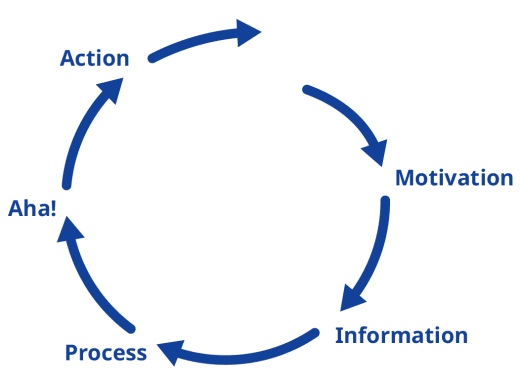
The Celemi Learning Spiral

Celemi has used the same learning model for 40 years:

Motivation

creates curiosity, relevance, and a reason to engage.

Information

gives participants the knowledge and context they need to engage with the experience.

Process

is where participants discuss, make decisions, interact, experience consequences, and reflect.

Aha!

is the insight that emerges as participants begin to see connections and understand the system differently.

Action

connects those insights to real work and what participants will do differently.

Business simulation vs. other learning formats

More than gamification

Gamification often adds points, badges, rankings, or rewards to an existing activity. A business simulation creates the decision environment itself. Participants take responsibility for outcomes and learn from the consequences of their choices. A business simulation is a gamified learning experience, but it is not gamification added to an existing activity.

More than a case study

A case study asks participants to analyse a situation that has already happened. A business simulation asks them to determine what happens next. Participants make decisions, experience the consequences, reflect on the results, and adjust their approach over time.

Explore business simulations in practice

See how Celemi business simulations are used to develop capabilities, support strategic change, and help people understand how decisions shape business performance.

Explore our simulations or talk to us about the business challenges and learning objectives you want people to work through.
© Celemiab Systems AB 2024. The trademarks and brand names displayed on this Website are the property of Celemiab Systems AB, its affiliates or third party owners. You may not use or display any trademarks or brand names owned by Celemiab Systems AB without our prior written consent. You may not use or display any other trademarks displayed on this Website without the permission of their owners.
crossmenu