Making the abstract concrete and why it matters.
What do merry-go-rounds and business have in common? If cash flow stops, so does the ride.
We’ve all heard the phrase “cash is king.” But in many organizations, even among seasoned managers, profit and loss statements get all the attention while cash flow quietly makes or breaks the business.
A profitable company can still run out of cash and fail. Why? Because business is more like a merry-go-round than a still photograph. Cash is constantly moving, and keeping it flowing at the right speed is critical to keeping the whole operation running.
Klas Mellander, in his book Apples & Oranges: Everything You Need to Understand Business Finance, explains it beautifully:
“A business is a merry-go-round of capital, and its speed matters.”
This perspective is more than a metaphor. For employees at every level, understanding cash flow and how their everyday decisions impact it is essential for building true business acumen.
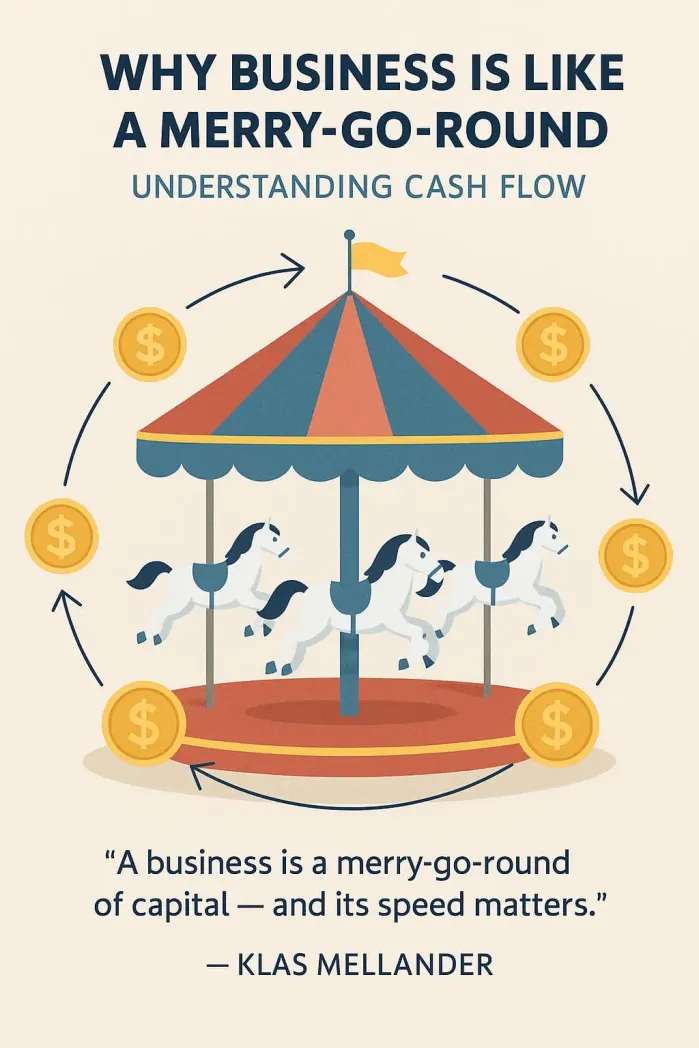
Seeing the big picture: the merry-go-round metaphor
Picture your business as a carousel. Money goes out to buy materials, pay employees, and cover overhead. That money becomes inventory, then finished products. When customers buy those products, money flows back in.
But here’s the catch. If you spend too much up front, produce too much inventory, or don’t collect fast enough from customers, the ride slows or even stops.
Healthy cash flow keeps the ride spinning. And the responsibility for that does not just sit with finance. Every employee’s decisions, from negotiating payment terms to managing stock levels to processing invoices quickly, contribute to keeping the flow moving.
Why cash flow matters more than profit in the short term
It’s entirely possible to report a healthy profit on paper while struggling to pay your bills. Why? Because profit measures value over time, while cash flow measures what’s actually in the bank right now.
As someone famously said:
“Profit is an opinion, cash flow is a fact.”
Imagine a company that just closed a large, profitable deal but doesn’t get paid for six months. Meanwhile, payroll and supplier bills come due next week. Without sufficient cash on hand, even a profitable business can hit a wall.
Understanding this distinction, and seeing how everyday actions impact cash flow, is the foundation of financial acumen.
Why employees at all levels should care about cash flow
One common misconception is that cash flow management is “a finance thing.” But in reality, decisions made in nearly every department affect it.
For example:
Sales teams influence cash flow by negotiating payment terms with customers and avoiding unnecessary discounts.
Operations and supply chain influence it through inventory management and supplier payment schedules.
Customer service can reduce delays in invoicing and payment disputes by keeping customers informed and satisfied.
Everyone can contribute by being mindful of waste, unnecessary spending, and efficiency.
The more employees see the big picture, the more aligned their actions are with the company’s financial health.
What you can do today
Even if you’re not in finance, here are three practical questions you can start asking to build awareness and improve the flow of capital:
Where is capital tied up unnecessarily? Look at excess inventory, overdue receivables, or long supplier terms.
How can we shorten the time between delivering value and getting paid?
How can we make better use of what we already have?
By looking beyond the P&L and focusing on the cash flow statement, you can uncover insights that keep your business moving forward and help avoid unpleasant surprises down the line.
A real-world example: freeing up millions
One manufacturing company we worked with saw steady profits but constant cash crunches. Through one of our simulations, employees discovered how much working capital was tied up in excess inventory and long customer payment terms.
They made changes to production planning, streamlined order-to-cash processes, and encouraged sales teams to negotiate shorter payment terms. Within months, they freed up millions in cash and no longer needed emergency loans to make payroll.
The key was not just process change but mindset change. When employees at all levels began to see the merry-go-round and their role in keeping it spinning, results followed.
Why financial acumen matters more than ever
In today’s business environment, cash flow pressures are intensifying. Rising costs, supply chain disruptions, and tighter credit mean that companies cannot afford to ignore the speed of capital.
This is why developing financial acumen is one of the most valuable investments you can make in your team. When employees understand the basics of business finance and cash flow, they make better decisions, identify risks earlier, and act more like owners.
At Celemi, we believe learning these principles does not have to be dry or intimidating. Our Serious Fun approach helps teams build financial acumen through engaging, hands-on simulations that make concepts like cash flow tangible and memorable.
Keep the ride spinning
Understanding cash flow is a small shift in perspective that can make a big difference in results. And it starts with everyone developing business acumen, not just the finance team.
Healthy cash flow fuels growth, stability, and resilience. Without it, even the most profitable business can grind to a halt.
Ready to talk?
If this sparked ideas, or if you’d like to explore how your team can build financial acumen through Serious Fun, let’s connect.
Request your copy of Apples & Oranges: Everything You Need to Understand Business Finance or
Start a conversation with us: https://celemi.com/contact
Let’s make business acumen everyone’s business, and keep your merry-go-round spinning.
Shared by Kjell Lindqvist, CEO of Celemi. At Celemi, we are dedicated to helping organizations around the world build financial literacy and business acumen at scale